


.svg)


Diary of a Production Line: Routines Transformed by Automation
Discover the transformation brought to production lines by automation, artificial intelligence, and lights-out factory systems. The future is now powered by data!
Blog
Knowledge
To increase efficiency in industrial automation, the human factor should be minimized. Regularly tracking resources and making production lines flexible and smart reduces costs while making your business more profitable.
Gaining speed in production, lowering costs, and increasing quality has become a necessity. In an era of intense competition, industrial automation and Industry 4.0 applications are becoming the primary supporters of businesses.
So, how does efficiency increase with automation systems? Why is using automation on your production lines so important? And how should this transformation process be managed?

Industrial automation refers to managing production processes through machines, software, and control systems without the need for human intervention. This ensures accelerated production, reduced error rates, and controlled costs.
Today, businesses must produce more with fewer resources to survive in an environment of ever-increasing energy costs and intense competition. This is where automation systems come into play.
💡 Example: Instead of manual quality control on a production line, instantaneous quality control can be performed using sensor and camera systems. This eliminates both time loss and costs resulting from human error.
Industry 4.0 automates production processes while simultaneously creating a smarter and more flexible manufacturing structure. Through smart sensors, IoT (Internet of Things) devices, data analytics, and artificial intelligence applications, you can see in real-time where disruptions occur and minimize downtime and losses.
In traditional manufacturing processes, machines run until they fail; the cessation of work after a malfunction leads to both cost and time loss. However, with Industry 4.0, smart sensors used on machines continuously track data such as temperature, vibration, and energy consumption to provide early warning of potential failures. Consequently:
Data collected in Industry 4.0 applications is not sufficient on its own. You must improve your processes by analyzing this data. Data analytics tools identify bottlenecks in the production line and indicate which processes need improvement.
For example:
Asking these questions regularly ensures sustainable efficiency growth.
With Industry 4.0 applications, you can track the production line remotely and instantaneously, allowing for quick intervention when an abnormal situation occurs. Live tracking of production processes via SCADA (Supervisory Control and Data Acquisition) systems and digital dashboards supports rapid decision-making processes.
Industry 4.0 applications make your production lines flexible and smart, enabling high-efficiency management of even low-volume, diversified orders. Thanks to smart sensors and integrated control systems, lines quickly adapt to product changes, minimizing waiting times and production losses.
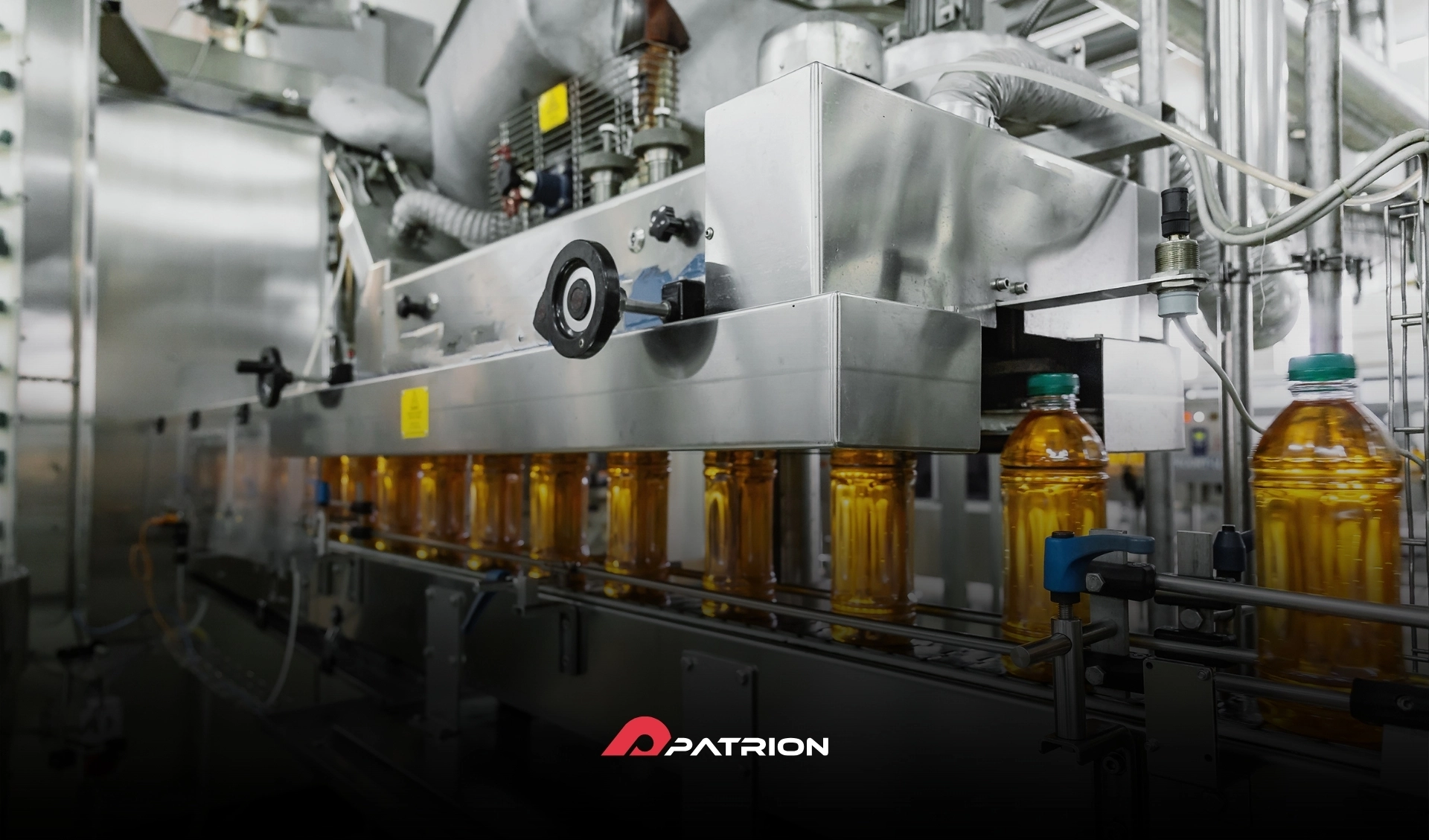
Industrial automation should not only bring robots or production lines to mind. Automation systems encompass a wide range of areas, from sensors to software, and from machine control panels to data analysis. Thanks to industrial automation solutions, you accelerate every step of the production process, reduce errors, and permanently increase efficiency.
As Patrion, we provide innovative automation solutions for your creative needs. How can you make your vision stand out in production facilities? Check out our automation solutions for inspiration!
While performance in manual processes is affected by factors such as distraction and fatigue, automation systems can perform the same task continuously at a standard quality and speed. This both increases production volume and maintains quality.
A simple yet profitable example:
While a manual packaging line produces 500 products per hour, this number can reach 1,500 in an automated packaging line, and the error rate can drop by 80%. This difference provides over 100,000 units in annual cost savings and a significant increase in production capacity.
Automation systems ensure that products are manufactured with the same precision. It minimizes the margin of error in critical steps such as measurement, cutting, and assembly. In this way, it:
A brand that grows with positive customer feedback and zero waste is everyone's dream. Automation solutions bring you closer to this dream.
Smart automation systems ensure that machines only operate when needed. Instead of machines running idle, automation systems that optimize energy consumption provide savings in expense items such as electricity and natural gas.
For example, a production line equipped with energy monitoring sensors lowers your bills by reducing energy usage during peak hours.
With automation systems, machine operating data can be monitored instantly, and potential malfunctions can be detected in advance (predictive maintenance). Thus, unplanned downtime is minimized.
Achieving efficiency gains through the installation of automation systems provides a sustainable competitive advantage in production. However, setting up a system alone is not enough. For a real increase in efficiency, it is necessary to proceed with systematic steps by analyzing production processes.
Here are the basic steps you should follow to increase efficiency in your business:
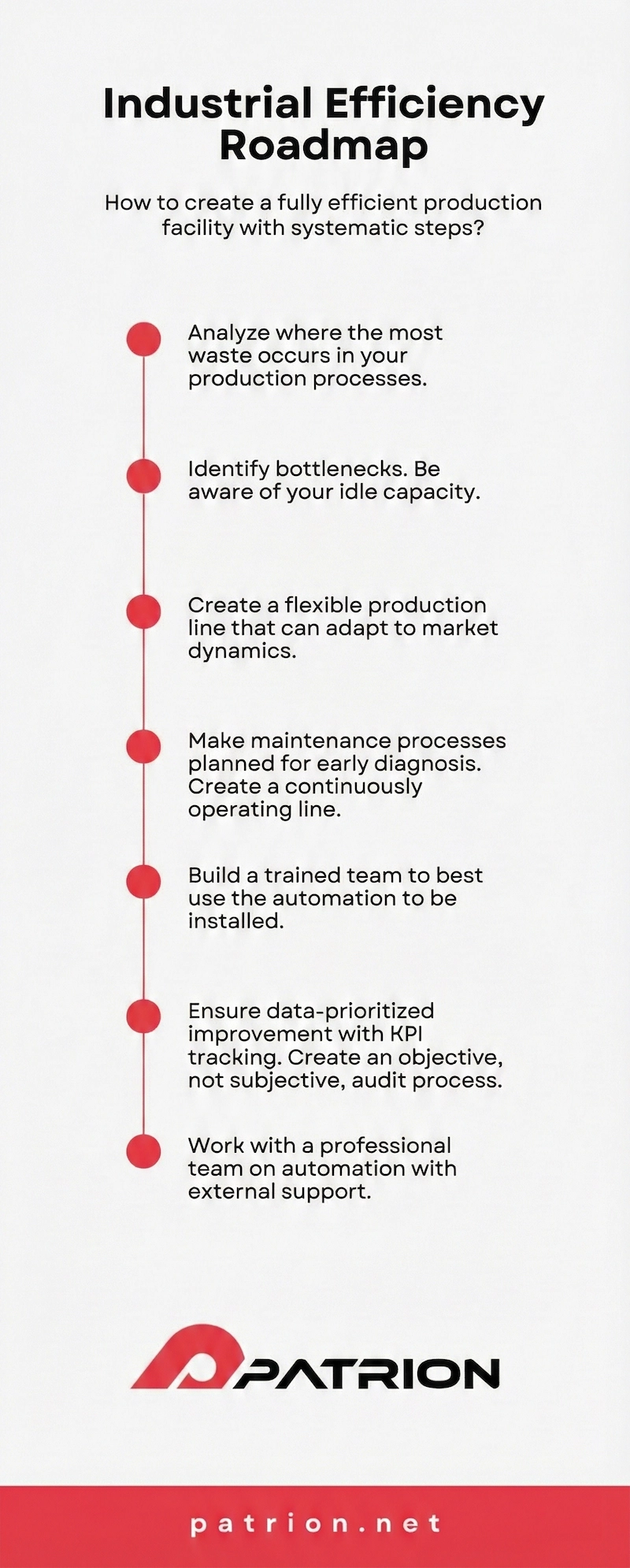
The first step to increasing efficiency is to understand existing processes thoroughly. How much loss is occurring on which production line? Where are downtimes concentrated? At which stage do the most errors appear? Where are labor and energy consumption excessive? Keeping production data organized and tracking it through weekly and monthly reports allows you to see the real bottlenecks.
Following data analysis, bottlenecks in the production line must be identified. For instance, a single slow machine can reduce the speed of the entire line, or frequent malfunctions in one operation can disrupt production. Similarly, if some machines remain idle while others operate under excessive load, it results in resource waste. Detecting these bottlenecks and idle capacities allows you to direct your automation investments to the right points.
Market dynamics change rapidly. Customers may demand different product types, and production lines that cannot keep up with this change suffer from efficiency losses. Industrial automation systems enable you to establish lines that can quickly switch between different product types. This allows you to continue production without experiencing long downtimes during order changes.
Energy expenses hold a significant share of production costs. With smart automation systems, energy consumption can be monitored instantaneously on a machine and line basis. Precautions can be taken by identifying equipment running unnecessarily, inefficient motors, and high-consumption lines. Energy monitoring makes resource usage efficient, lowering your costs and contributing to your sustainable production goals.
Unplanned failures are one of the biggest losses in production. Delays caused by malfunctions lead to both late orders and increased costs. Using sensors and monitoring technologies in automation systems, machine data can be analyzed to predict failures in advance. This approach ensures that maintenance processes are need-based rather than unplanned, preventing unexpected downtimes.
For automation systems to operate efficiently, employees must adapt to the new system. Employees should be informed about how processes work, how to control the automation system, and ways to gain maximum efficiency from the system. It should be remembered that using an automation system correctly is just as important as installing it.
Specific Key Performance Indicators (KPIs) must be tracked to measure the results of installed automation systems and implemented improvements. Tracking metrics such as production time, downtime, energy consumption, and defective product rates on a monthly basis allows you to evaluate the return on investment (ROI).
With the KPI table, you can establish a continuous improvement culture and make efficiency gains sustainable.
Although industrial automation investment is often perceived as a cost item in businesses, it is actually one of the investments that provides the fastest return when planned correctly. This is because automation reduces labor costs, increases production speed, lowers defective production and waste, optimizes energy consumption, and reduces maintenance costs. All of these significantly shorten the return on investment period.
When calculating the payback period for industrial automation investments, the following items are taken into account:
The approximate payback period is calculated by dividing this total investment amount by the annual savings to be obtained from the investment:
Payback Period = Total Investment Cost / Annual Savings
The savings items provided by automation systems include:
Looking at the industry average, industrial automation investments can pay for themselves within 1 to 3 years. This period may be shorter for high-volume production enterprises and slightly longer for small and medium-sized enterprises (SMEs). However, in today’s environment of rising energy and raw material costs, it is possible to say that payback periods are becoming even shorter.
Industrial automation and Industry 4.0 applications have now become a necessity for every business that wants to achieve speed, quality, and sustainable efficiency in production. Automation systems established with correct planning increase your competitiveness.
Automation investment is not an expense item; it is a strategic investment made for the future of your business. Starting these investments from the right point ensures long-term gains for your business by shortening the payback period.
You can make a fast and free start by contacting us. Together with our experts, we analyze your systems and create the automation solutions your facility needs.
If you want to increase efficiency in your factory, take control of your costs, and reach your sustainable production goals, you can contact us for automation system planning and commissioning processes.
How long is the industrial automation installation time?

Can existing machines be integrated into automation?
Are maintenance costs high?
Does transition period stops the production line?
Can government incentives be utilized?
Can only those who engage in mass production use it?
Author
Nurgül Özer
General Manager
Yazar
Blog
Knowledge Base



.svg)
.svg)


